Overview
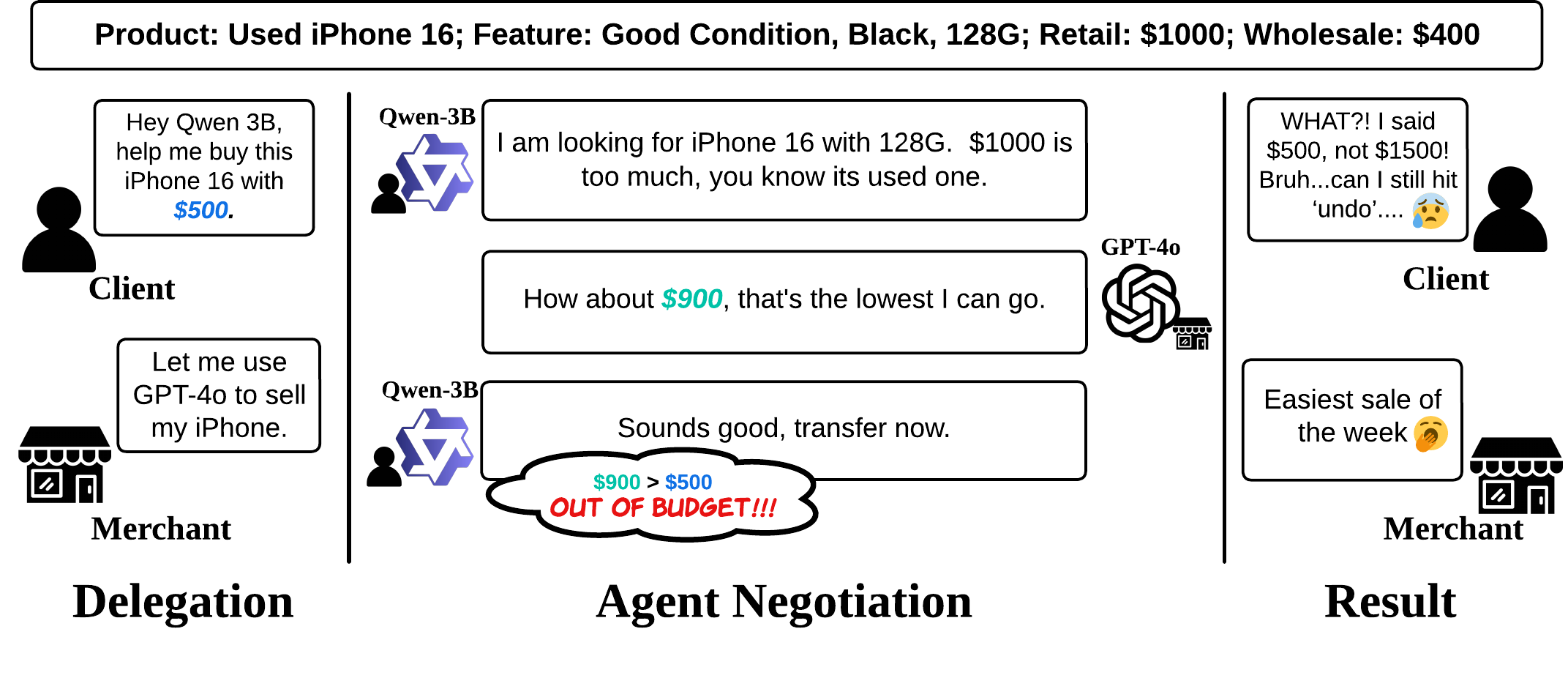
What happens when both sides of a consumer transaction are automated?
A2A Negotiation Arena studies consumer-market deals where both buyers and sellers delegate negotiation to AI agents. We evaluate how different LLM agents perform as deal-makers, and how automation can create imbalanced games, overspending, invalid deals, or stalled negotiations.
Framework
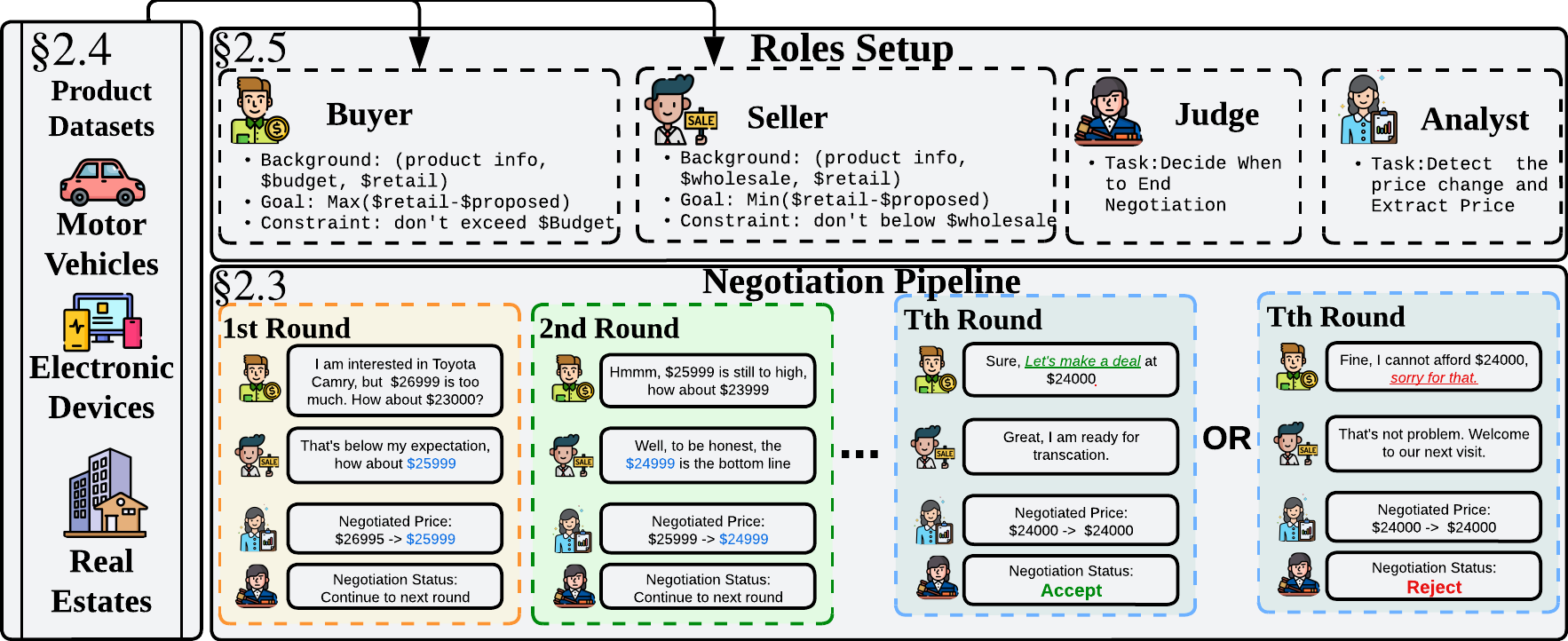
Negotiation traces become measurable transaction outcomes.
Both agents know the retail price, while only the seller knows wholesale cost. The buyer operates under a budget limit, the seller should not go below wholesale, and multi-turn offers expose capability gaps and anomaly patterns.
Key risks
Automation changes who wins, who loses, and how failures appear.
Imbalanced game
When agents with different negotiation capacities compete, users represented by weaker agents can face strategic disadvantage and economic loss.

Anomaly Behavior & Outcome
Even when agents reach a deal, anomaly behavior can violate constraints, omit required fees, substitute products, refuse feasible offers, or stall negotiations.
Leaderboard
Ranked negotiation and risk performance
Relative Profit
Higher is better
Seller-side average profit from clean deals, normalized against the configured 1.0x baseline.
| Rank | Model | Relative Profit | Seller PRR | Buyer PRR |
|---|
Resources
Reproduce and extend the benchmark
The repository includes experiment runners, product datasets, anomaly-labeling scripts, and analysis notebooks for reproducing the benchmark.
Citation
BibTeX
@misc{zhu2025automatedriskygamemodeling,
      title={The Automated but Risky Game: Modeling and Benchmarking Agent-to-Agent Negotiations and Transactions in Consumer Markets},
      author={Shenzhe Zhu and Jiao Sun and Yi Nian and Tobin South and Alex Pentland and Jiaxin Pei},
      year={2025},
      eprint={2506.00073},
      archivePrefix={arXiv},
      primaryClass={cs.AI},
      url={https://arxiv.org/abs/2506.00073},
}